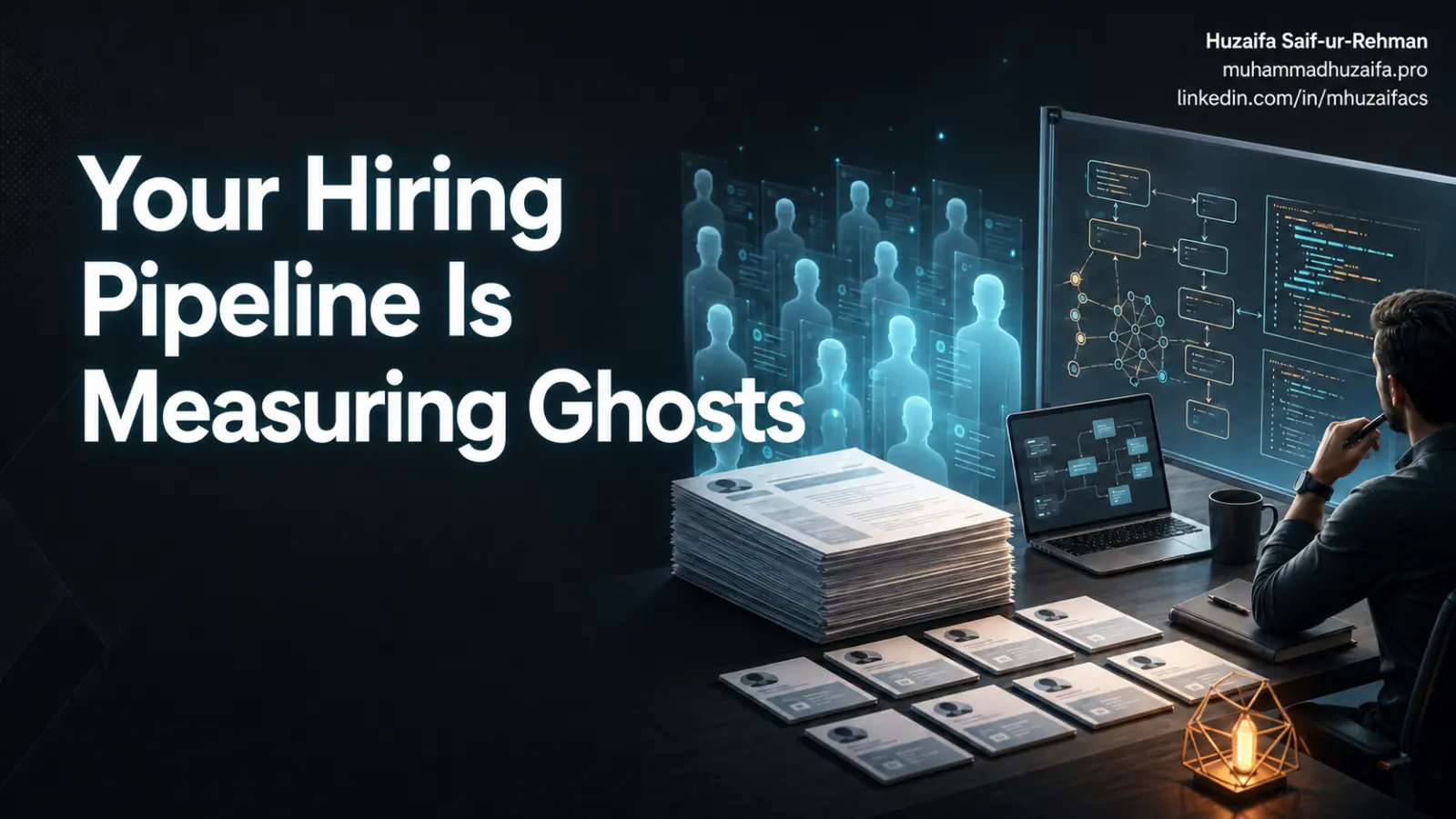
Your Hiring Pipeline Is Measuring Ghosts
Published on — Last updated
There is a new problem showing up in engineering hiring pipelines, and it is one we built ourselves.
Tom MacWright calls it "accidental anonymity." Candidates submit LLM-written resumes, link to LLM-generated portfolio sites, which point to LLM-generated GitHub projects with LLM-generated commit messages. Every artifact is polished, coherent, and completely impersonal. You learn nothing about the person behind them.
The resume hits every keyword. The portfolio looks professional. The GitHub has green squares. But there is no signal -- no evidence of how this person thinks through a tradeoff, debugs something unfamiliar, or makes an architectural call when the path is unclear. The LLM filled every gap with plausible competence. Now every candidate looks the same.
This is not a candidate quality problem. It is a signal problem. For years we trained hiring pipelines to scan for polished artifacts -- resumes with the right keywords, portfolios with clean projects, contribution graphs. Those were always proxies. The LLM just exposed how weak they were.
The fix is not AI detection. It is designing interviews that measure what LLMs cannot fake. A live debugging session on an unfamiliar codebase. A 30-minute architecture discussion where you change the constraints three times. A judgment call on which part of a system to optimize and which to leave alone.
If your top-of-funnel screening can be passed by a candidate who never touches a keyboard, your hiring pipeline is measuring the wrong thing.