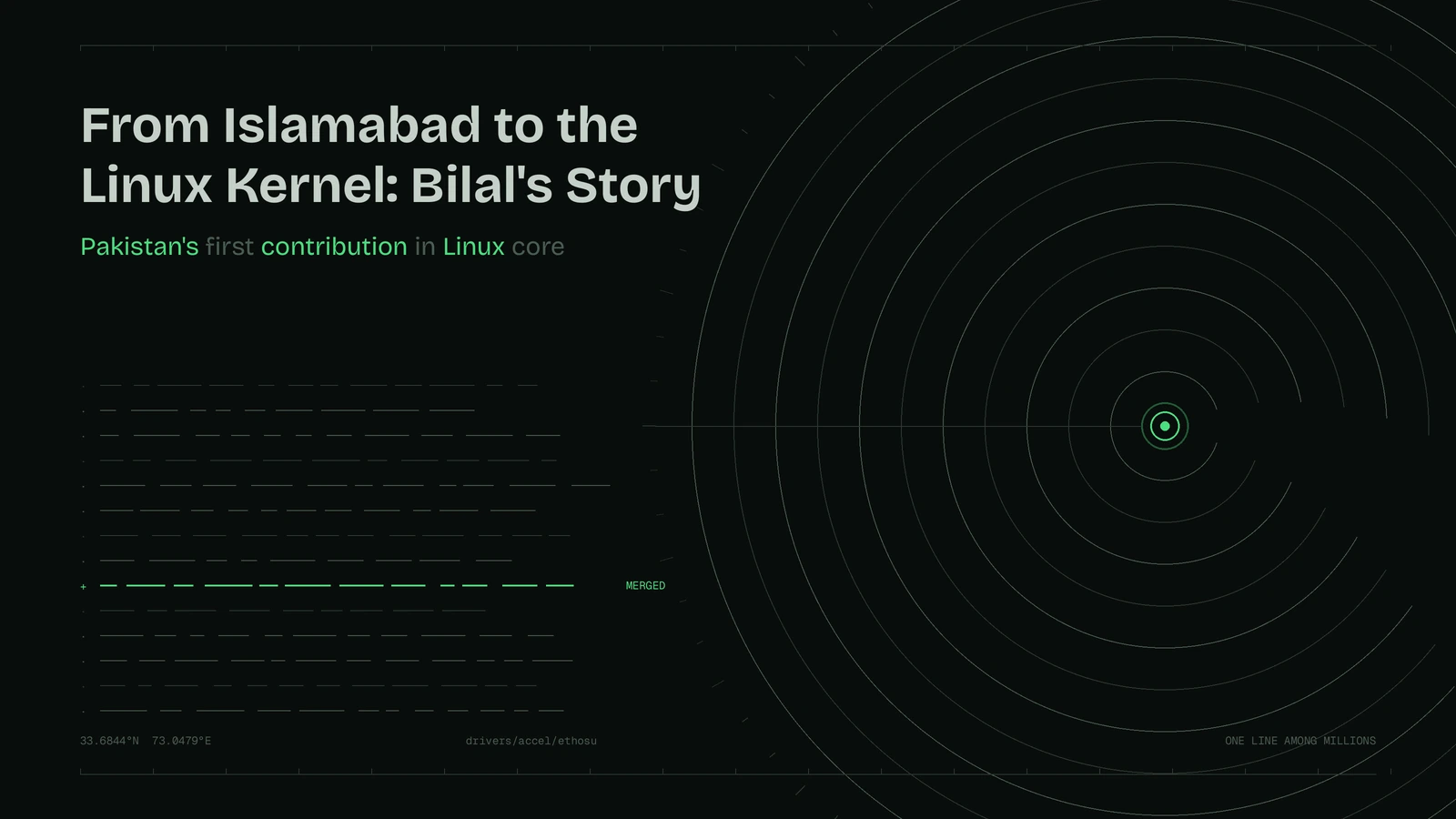
From Islamabad to the Linux Kernel: Bilal's Story
Published on — Last updated
Correction, July 15, 2026. An earlier version of this post said Bilal may be the first Linux kernel contributor from Pakistan. That was wrong. Muhammad Usama Anjum has been contributing to the core kernel for years, with more than 80 upstream contributions. My sincere thanks to Maaz Khalid from the Laravelian community for the prompt correction. The post has been updated below.
Does Pakistan have a Linux kernel contributors? Yes, Muhammad Usama Anjum has been contributing to the core kernel for years, and now a computer science student at Iqra University Islamabad is also a Linux kernel contributor from Pakistan, one of a small group of Pakistani developers with code merged into the core kernel.
From Islamabad to the Linux Kernel, Bilal's Story
Muhammad Bilal, a BS Computer Science student at Iqra University's H-9 Campus in Islamabad, has done something very few developers anywhere in the world ever manage. He got his code accepted into the official Linux kernel, the software at the heart of Android phones, cloud servers, supercomputers, and billions of devices worldwide.
A proud moment for Iqra University, H-9 Campus
This is exactly the kind of hands-on, real-world impact universities dream of seeing from their students. The Linux kernel is one of the largest and most rigorously reviewed open-source projects in existence. Code doesn't get in because you ask nicely. It gets in because experienced maintainers, some of whom have spent decades on the project, examine every line and decide it makes the kernel better.
Bilal's patch went through that gauntlet and came out merged. Huge congratulations from the entire IU H-9 Campus family.

Why getting code into the Linux kernel is a big deal
The Linux kernel has thousands of contributors from companies like Google, Intel, Arm, and Red Hat. Every proposed change, called a patch, is posted publicly to the kernel mailing lists, where subsystem maintainers review it, question it, and often send it back for revisions, sometimes several times. Only changes that survive this review are merged into the official tree.
For a working professional this is a serious achievement. For an undergraduate student doing it from Pakistan, it is remarkable. It takes real technical depth, precision, and above all, persistence.
Pakistan already has a kernel veteran, meet Muhammad Usama Anjum
When I first published this post I believed Bilal might be the first contributor to the core Linux kernel from Pakistan. I was excited, and I was wrong. Maaz Khalid from the Laravelian WhatsApp community reached out with a correction, and I am grateful he did.
Muhammad Usama Anjum is a Linux kernel developer from Pakistan who has been doing this work upstream for years. He has more than 80 contributions in the official kernel tree, working on core kernel areas like memory management and kernel selftests. His best-known work is the PAGEMAP_SCAN ioctl, a memory-tracking interface he authored at Collabora that was merged in Linux 6.7 and covered by LWN. He has also spoken at Open Source Summit Europe and the Linux Plumbers Conference.
So Bilal is not the first, and honestly that is even better news. Pakistan does not have one kernel contributor. It has a senior one who has been quietly doing it for years, and now a student following the same path. Alhamdulillah.
A milestone for Pakistan's open-source community
Developers from Pakistan have long contributed to major open-source projects. WordPress, Laravel, and countless libraries and tools carry Pakistani names in their commit histories.
The core Linux kernel is rarer territory, and Usama's years of upstream work along with Bilal's merged patch show it is firmly within reach. Kernel development is not out of reach for developers and students here
A personal message to Bilal
Bilal, you have written your name in history in a way that will never be forgotten. Your achievement will continue to inspire future generations.
This was also one of my own dreams, something I could not accomplish myself, so seeing you achieve it brings me immense happiness. Honestly, I cannot fully express how proud and delighted I feel about what you have done. Thank you.
My sincere prayer for you is that you complete your studies with full dedication and continue making Pakistan proud through your work. I also hope that one day we will have the opportunity to learn something from you.
To every student reading this
The Linux kernel's development happens entirely in public. The code, the mailing lists, the review discussions, all of it is open to anyone with curiosity and patience. Bilal didn't need permission, connections, or expensive tools. He needed skill, care, and the persistence to keep revising until his work met the bar.
The next contribution from Pakistan doesn't have to wait years. It might be yours.
If you want to get started with kernel contributions, begin with the official kernel newbies guide and the kernel's own documentation on submitting patches.
Sources
- Linux Kernel Mailing List archive, May 2026 thread index — Bilal's ethosu patch submissions (v1–v3, DMA length validation)
- Patch: accel/ethosu reject NPU_OP_RESIZE commands from userspace — technical details of the WARN_ON/DoS fix
- Kernel Newbies — linked in the post for readers
- Muhammad Usama Anjum — LinkedIn and personal site — 80+ upstream kernel contributions, conference talks
- LWN, An ioctl() call to detect memory writes — coverage of his PAGEMAP_SCAN work
- Collabora, Kernel 6.7 release notes — PAGEMAP_SCAN merged in 6.7
- Correction credit — Maaz Khalid, Laravelian WhatsApp community, 2026-07-15