Pakistan launched a coordinated set of national AI initiatives through 2026, built on the National AI Policy 2025 and centered on seven new AI hubs, a public sector compute buildout, and a pledge to train one million people in AI skills. Some of this is operational today, other parts are still commitments with delivery dates ahead. This piece separates the two and explains what each initiative actually involves.
The policy foundation, National AI Policy 2025
Everything discussed here traces back to one document. On July 30, 2025, Pakistan's federal cabinet approved the National AI Policy, the country's first formal AI strategy. The policy sets a 2035 vision of Pakistan as a leading AI hub in South Asia and organizes its approach around six pillars, an AI innovation ecosystem, mass awareness and readiness, a secure AI ecosystem, sector transformation, nationwide AI infrastructure, and international collaboration.
The policy also carries specific economic projections. Government estimates cited alongside the policy suggest AI adoption could help lift GDP growth from around 7 percent toward 15 percent by 2030, with sector level gains estimated at 12 billion dollars in agriculture, 5 billion dollars in industry, and 26 billion dollars in services. These are policy projections, not measured outcomes, and should be read as the government's stated ambition rather than a verified result.
The policy also created the mechanism for a National AI Fund intended to back startups and research, and it calls for AI literacy through curriculum reform. Most of what follows in 2026 is the government building out the implementation layer for this policy.
The National AI Advancement Initiative and its seven hubs
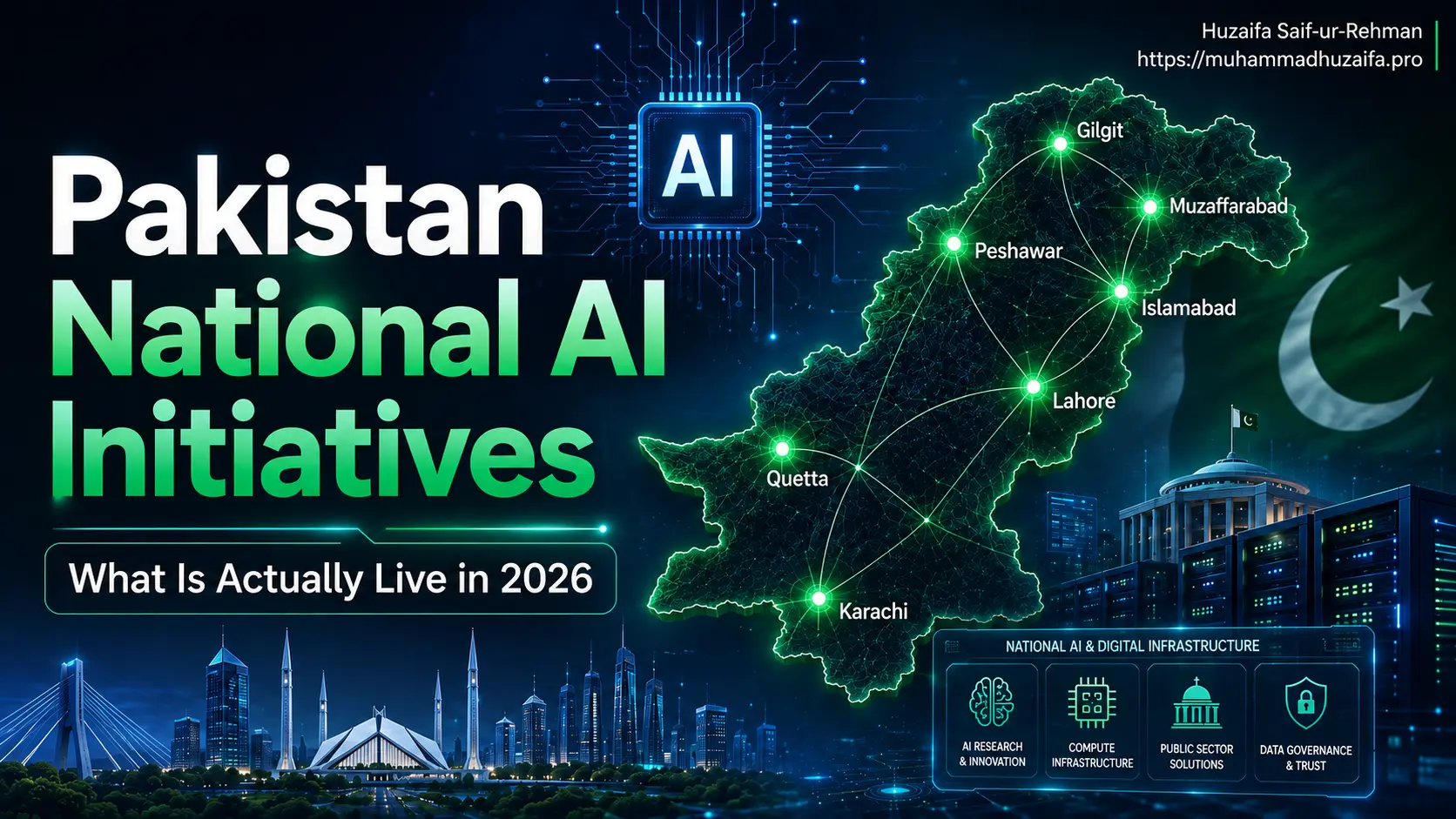
In July 2026, the Ministry of Information Technology and Telecommunication launched the National AI Advancement Initiative, referred to as NAAI, as the first major implementation vehicle for the 2025 policy. NAAI's centerpiece is a network of seven AI hubs distributed across the country rather than concentrated in one city.
Where the hubs are and what they focus on
The seven hubs are located in Islamabad, Lahore, Karachi, Peshawar, Quetta, Muzaffarabad, and Gilgit. Each hub is planned to include modern office infrastructure, high speed internet, collaboration spaces, mentorship facilities, and dedicated workspaces for founders and teams. The stated focus areas are healthcare, agriculture, education, fintech, public sector governance, and smart cities, chosen to reflect practical, sector specific AI applications rather than general purpose research.
The government's framing for the geographic spread is to connect startups, academia, industry, investors, and government institutions into what it describes as a unified ecosystem, and to position Pakistan as a regional center for AI development rather than a single city cluster.
The startup incubation and seed grant model
NAAI targets incubating 560 startups over two years. Each hub is designed to induct 20 AI startups per cohort, running two cohorts a year, which works out to 40 startups annually per hub across the seven locations. Alongside incubation, the initiative includes non dilutive seed grants for 150 founders, meaning recipients do not give up equity in exchange for the funding. For early stage founders, this is a materially different offer than typical accelerator terms, and it is worth verifying current application windows directly with MoITT or the relevant hub before assuming eligibility, since program details for fast moving government initiatives can shift between announcement and rollout.
Public sector AI infrastructure, the compute buildout
A national AI strategy needs compute, and Pakistan's public sector took a concrete step on this in July 2026. The National Telecommunication Corporation, NTC, signed a three year agreement with Data Vault Pakistan to provide high performance Graphics Processing Unit as a Service and Model as a Service to government institutions. In practical terms, this is meant to give public sector bodies access to GPU capacity and hosted model infrastructure without each ministry or agency having to build and maintain its own hardware.
This is a notable shift because compute access has been one of the more concrete bottlenecks separating AI policy documents from usable government AI systems in many countries. Whether this deal delivers enough capacity, at the right cost and reliability, for meaningful public sector AI workloads is something that will only be verifiable as institutions actually start using it.
The one million person AI training pledge
In June 2026, IT and Telecom Minister Shaza Fatima Khawaja detailed a government plan to train one million people in AI over three years. The plan includes free AI training for students and the recruitment of additional trainers to deliver it. This builds directly on the National AI Policy's mass awareness and readiness pillar and reflects a broader pattern across 2026, several of Pakistan's AI announcements are aimed at building a trained workforce rather than only funding startups or infrastructure.
Readers evaluating this pledge should treat the one million figure as a three year target rather than a completed outcome, and should look for interim reporting on actual enrollment and completion numbers as the program matures.
AI in government operations, the Prime Minister's Office System
Separate from the hub and training initiatives, the government has also been applying AI directly to its own operations. On June 17, 2026, Federal Minister for Economic Affairs Ahad Cheema chaired a review of the Prime Minister's Office System, known as PMOS, described as an AI powered platform intended to strengthen governance, improve inter ministerial coordination, and monitor the progress of government initiatives. This is one of the more direct examples of AI being used inside Pakistan's own administrative machinery rather than only being promoted externally to industry and startups.
Provincial programs, the Khyber Pakhtunkhwa AI Innovation Hub
National initiatives are not the only activity. In July 2026, the Khyber Pakhtunkhwa Information Technology Board unveiled its own two year AI Innovation Hub project, aimed at training 1,500 government school teachers and 1,000 government officers. This provincial program runs alongside the federal NAAI hubs and points to a pattern worth watching, provinces are not waiting on federal rollout timelines to launch their own AI capacity building, which could mean faster but more fragmented progress across the country.
What is proven versus what is still a pledge
For a reader trying to act on this information, the distinction between operational and pledged matters more than the announcement date. As of mid 2026, the following are documented as launched or contractually signed, the National AI Policy approval in July 2025, the NAAI hub announcement and its seven locations, the NTC and Data Vault Pakistan compute agreement, and the Khyber Pakhtunkhwa hub launch.
The following are stated targets with delivery still ahead, the 560 startup incubation figure and the 150 non dilutive seed grants, the one million person training goal, and the broader GDP and sector level economic projections tied to the 2025 policy. None of these should be treated as completed until independently reported progress data becomes available.
How developers and founders can engage
For a developer or founder deciding whether these programs are relevant, three entry points stand out. First, the NAAI hubs are the clearest startup facing mechanism, and founders working in healthcare, agriculture, education, fintech, governance, or smart city applications are the closest fit for the stated focus areas. Second, the training pledge is the most accessible entry point for individuals rather than companies, since it targets students and non IT professionals directly. Third, the compute agreement between NTC and Data Vault Pakistan is primarily aimed at government institutions rather than private founders, so it is less directly actionable for most developers, but it is a useful signal of where public sector AI capacity is headed.
Before applying to or planning around any of these programs, verify current details directly with MoITT, the relevant provincial IT board, or the specific hub, since implementation specifics for government programs frequently get refined after the initial announcement.
What to watch next
The clearest signal of whether 2026's initiatives are working will come from execution data rather than further announcements, actual startup cohort numbers at the seven hubs, verified training enrollment against the one million target, and reporting on how government institutions are actually using the NTC and Data Vault compute agreement. Readers tracking this space should watch for MoITT progress updates and independent reporting rather than relying on launch announcements alone.