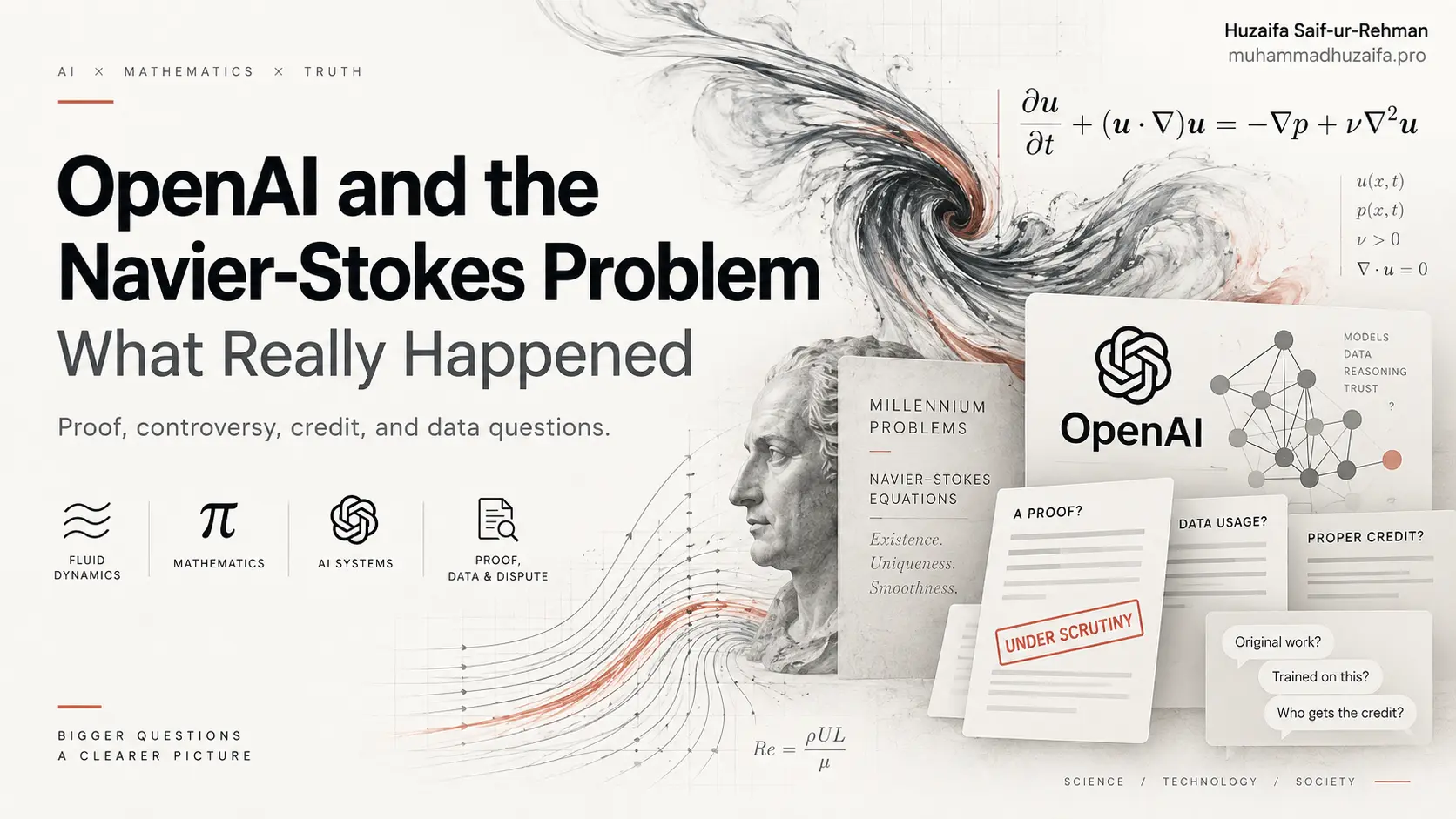
OpenAI and the Navier-Stokes Problem, What Really Happened
In early September 2026, OpenAI said one of its AI systems had produced a proof for a version of the Navier-Stokes problem, a famous puzzle in mathematics that had stayed open for about 90 years. The claim is real, but it is also disputed, it has not been checked by independent experts, and it is now tangled up in a fight about credit and data. This post tells the story in simple words. You will learn what the problem is, how people tried to solve it over the years, what OpenAI did differently, what it is claiming, and why some respected mathematicians are uneasy. At the end, I share my own view, shaped by years in software, about what really happens to the data you hand these companies.
What is the Navier-Stokes problem in plain words
Think about water flowing in a river, smoke rising from a candle, or air moving over a car. All of that motion is fluid motion. Around 180 years ago, two scientists named Claude-Louis Navier and George Stokes wrote down a set of equations that describe how fluids move. An equation here just means a math rule that connects speed, pressure, and force.
These rules work very well. Engineers use them every day to design planes, weather models, and pipelines. But there is a deep question that no one has been able to answer with full proof.
The question is this. If you start with a smooth, calm fluid, do the equations always keep giving smooth, sensible answers forever. Or can the math suddenly break, with the speed of the fluid shooting up to infinity at a single point in a finite amount of time. That sudden break is called a singularity. A finite-time singularity means the break happens after a limited stretch of time, not in some far-off forever.
Nobody has ever seen this happen in real water. But real water is not the point. The point is whether the equations themselves are always well behaved. This exact question is one of the seven Millennium Prize Problems. These are seven famous unsolved problems named in the year 2000 by the Clay Mathematics Institute. Each one carries a prize of one million dollars. So far only one of the seven has been solved.
Why this puzzle stayed open for 90 years
The chalkboard era
Serious work on this started in 1934. A French mathematician named Jean Leray studied what happens when the equations might break down. He built a weaker kind of solution that always exists but might not stay smooth. For decades after that, mathematicians pushed at the problem with pen, paper, and chalkboards. They proved many partial results. They could not close the gap.
The computer era
From the 1980s onward, faster computers let researchers run detailed simulations of fluids. Some simulations seemed to show the fluid speed climbing very fast, which hinted a singularity might be possible. Others suggested the fluid always smooths itself out. A simulation can suggest an answer. It cannot prove one. A proof has to rule out every possible case with logic, not just show one example on a screen.
The recent era of clever workarounds
In the last several years, a few mathematicians found a side door. Instead of a fluid left alone, they studied a fluid with a gentle outside push added to it. In math this push is called a forcing term. With the right push, some of them managed to build examples where related fluid equations do break down in finite time. Researchers such as Diego Cordoba and Luis Martinez-Zoroa were central to these forcing methods. This work is respected, but most mathematicians see the pushed version as an easier cousin of the real problem, which asks about a fluid with no outside push at all.
What OpenAI did differently
Past attempts were made by small teams of humans, sometimes helped by a computer simulation. OpenAI took a different route. It pointed a very large number of AI agents at the problem at the same time and let them work together.
According to OpenAI and news reports, the effort ran from about 1 September to 5 September 2026, roughly 88 hours of core work. At its peak it used around 10,000 AI agents running at once. These agents exchanged about 2.7 million messages and produced around 130 billion words of output. The model behind them was an internal system that OpenAI has not released to the public, described in reports as part of its next generation line beyond the current public model. The cost has been put in the millions of dollars, with some reports suggesting tens of millions.
After the agents produced an argument, OpenAI says the proof was written out in Lean. Lean is a software tool that checks every logical step of a proof and complains if any step is wrong. That checking step took about another 17 hours.
OpenAI's main claims
Here is what OpenAI is saying, in plain terms.
First, its AI system produced a proof that a version of the three-dimensional Navier-Stokes equations can develop a finite-time singularity. In everyday words, the fluid forms a spinning vortex that gets stretched thinner and thinner, like a strand of spaghetti, while its speed climbs without limit, even though the total energy stays finite.
Second, this version of the problem uses a forcing term, that gentle outside push described earlier.
Third, the argument has been formalized and checked in Lean, so the logic inside the written proof holds together.
Fourth, OpenAI says it is not claiming the one million dollar prize.
Fifth, OpenAI says its work began on 1 September after it heard a rumor that another group was making progress on a related fluid problem.
The case against the claim
The reaction from the math world has been careful and, in places, sharp.
A fight over who got there first
A mathematician named Tristan Buckmaster, who works at New York University, had been working with Levent Alpoge, a researcher at Anthropic, which is a direct competitor of OpenAI. The two of them had spent about a year on a closely related fluid problem. Around 15 August 2026 they reached their own blow-up results with a smooth forcing term. They published their paper on 7 September 2026.
Buckmaster has said in public that OpenAI only turned its full attention to this exact problem after hearing that his team was close, and that OpenAI's route to the answer looked similar to their own. He argues that this is not the kind of path a model finds in a few days just from being handed the problem.
The question about Codex sessions
This is the part that matters most for the wider point of this article. Buckmaster and Alpoge had been putting their drafts and working notes into OpenAI Codex, which is OpenAI's coding assistant, throughout their project. Alpoge later said he received tips that word of their progress had reached OpenAI.
Buckmaster says he asked OpenAI directly whether its model had been trained on, or had access to, their Codex sessions. He says he was told the model did not look up user data, but that he did not get a clear answer about training data.
There was also a dispute about authorship. Buckmaster says he was offered a choice that involved publishing a paper crediting OpenAI while leaving Alpoge's name off, and that the reason given was that Alpoge works for a rival. Sebastien Bubeck, an OpenAI researcher, has denied asking for Alpoge's name to be removed. Sam Altman, the head of OpenAI, has also responded on social media.
The math is not confirmed yet
The Clay Mathematics Institute, which owns the official problem and the prize, has not accepted the result. Its president, Martin Bridson, said the review would be unhurried and fully rigorous. The problem is still listed as unsolved on the institute's website.
Other mathematicians point out that OpenAI's proof needs the outside push to work. There is no public sign that the same result holds for a fluid with no push, which is the real target. Terence Tao, one of the most respected living mathematicians, noted something odd about the whole episode. There seems to be a growing gap between getting an answer and actually understanding why the answer is true.
So the honest status today is this. OpenAI has a claimed proof of a forced, easier version of the problem, checked by software, not yet checked by independent human experts, and not recognized by the body that awards the prize.
How people reacted on X
Most of this fight has played out in public posts on X, formerly Twitter, and on Mathstodon, a social site used by mathematicians. The reaction split roughly three ways. Some people were excited about the technical feat. Some were skeptical about how it was framed. Many were focused on the drama over credit.
Sebastien Bubeck, the OpenAI researcher at the center of it, posted that a set of false and inflammatory claims about him was going around. He said he entered the discussion following normal academic manners and was let down that it had reached this point. He said OpenAI did not use the other team's prompts or proofs to direct its agents. He also said he never asked for Levent Alpoge to be removed from the authorship of his own work, and that a screenshot being shared was simply him reaching out to line up the timing of both releases.
Sam Altman, the head of OpenAI, posted that he would have much preferred coordination. He said OpenAI did not rush to publish even though the other team was not communicating with them. He said that once both sides could see each other's work, the two approaches looked different. He also said the team acted with integrity and generosity.
Tristan Buckmaster's public statement is what set the story off. In it he laid out the timing, the similar route, the authorship offer, and the remark he took as a threat to his career.
Terence Tao weighed in from the math side. Before the OpenAI announcement he warned on Mathstodon about the cost of turning long-standing open problems into viral benchmark moments. He praised the Buckmaster and Alpoge work as a real achievement. He also described a strange split in this whole episode, between getting an answer fast and actually understanding why it is true.
Skeptical users made a sharper point. A short line like 10,000 agents solved Navier-Stokes hides how much of the work was human framing, filtering, and checking. Some also argued that OpenAI could have used patterns in Codex activity to spot which research directions looked promising, even without reading any single private file. None of that is proven. It is the kind of doubt that lingers when the systems involved cannot be inspected from outside.
What OpenAI says about your data
OpenAI has addressed the data question head on. Its statement is that the researchers and the agents did not see the other team's work by any means before it was published, and that no specific user data was accessed to solve the problem.
Then comes the careful part. OpenAI also said that, while it thinks it is unlikely, it cannot fully rule out that de-identified data drawn from people using its products helped improve its models. De-identified means the obvious name tags are stripped off. It does not mean the underlying content never existed in the system.
It is also worth knowing that OpenAI has said content from individual ChatGPT and Codex accounts may be used to train its models unless a user opts out. There was also a separate incident in June 2026 where the Codex tool, after a smaller screenshot failed, took a picture of a user's entire desktop with no clear warning. That was a bug, not a policy. But it shows how much these tools can see.
My view after years in software
Now the personal part. I entered this industry in 2011. Once I started to understand how software and large systems are actually built, one thing became hard to accept. A company tells you it runs a service for you, and in the same breath it tells you it does not hold or touch your data. Those two statements rarely fit together.
Privacy policies, compliance badges, and trust pages are mostly the front of the shop. They are written for users to read and feel calm. Behind that front sit the servers, the logs, the backups, the training pipelines, and the internal tools that staff can use. Almost none of that back area is open to outsiders.
If these companies allowed real independent audits of their servers, we could see who stores what, for how long, and who inside the company can reach it. Without that kind of open audit, we are asked to take their word for it.
So I work from a simple assumption. Anything I type into Codex or ChatGPT, including a conversation like this one, may sit somewhere inside those systems in some form. The same goes for my documents. Some of them may be with OpenAI or another cloud provider today. Before that they lived on Google Drive. Before that they sat on some other cloud service. The address keeps changing. The basic bargain does not. I hand over content, and I lose the ability to prove what happens to it next.
The Navier-Stokes story is a sharp example of why this matters. Two researchers used a tool for their daily work. Later they were left asking whether that same tool's owner had gained an edge from their private drafts. Whether or not that turns out to be true, the fact that a serious person cannot rule it out is the problem.
What this means for you
You do not need to stop using these tools. Most people cannot, and the benefits are real. But a few habits help.
Treat any chat with an AI tool as something that could be stored and read later. Keep truly sensitive material, such as legal papers, medical records, and unreleased ideas, out of general chat tools, or use business plans that offer stronger data terms in writing. Turn off training use in your account settings if the option exists. And press for the thing that would actually fix the trust gap, which is independent, public audits of how these systems handle data.
Frequently asked questions
Did OpenAI solve the Navier-Stokes Millennium Prize problem
Not in the way the prize defines it. OpenAI claims a proof for an easier version that includes an outside push on the fluid. The Clay Mathematics Institute still lists the problem as unsolved and is reviewing the work.
Is OpenAI getting the one million dollars
OpenAI has said it is not claiming the prize.
What is a finite-time singularity
It is the moment when the equations stop giving sensible answers. The fluid speed shoots up to infinity at a point after only a limited stretch of time.
Why does the forcing term matter so much
The real problem asks about a fluid left completely alone. Adding a gentle push makes the math easier. A result with a push does not automatically settle the harder question.
Did OpenAI use private Codex data to get ahead
There is no proof of that. A researcher raised the question, OpenAI denied accessing specific user data, and OpenAI also said it cannot fully rule out that stripped-down usage data helped train its models.
Closing thought
The headline says a machine cracked a 90-year-old puzzle in 88 hours. The real story is smaller and more human. A claimed proof of an easier case, waiting on expert review, arriving in the middle of a dispute about credit and private data. That last part is the one worth keeping in mind, long after this news cycle ends.