NYC Banned AI for Kids, Here Is Why That Is Right
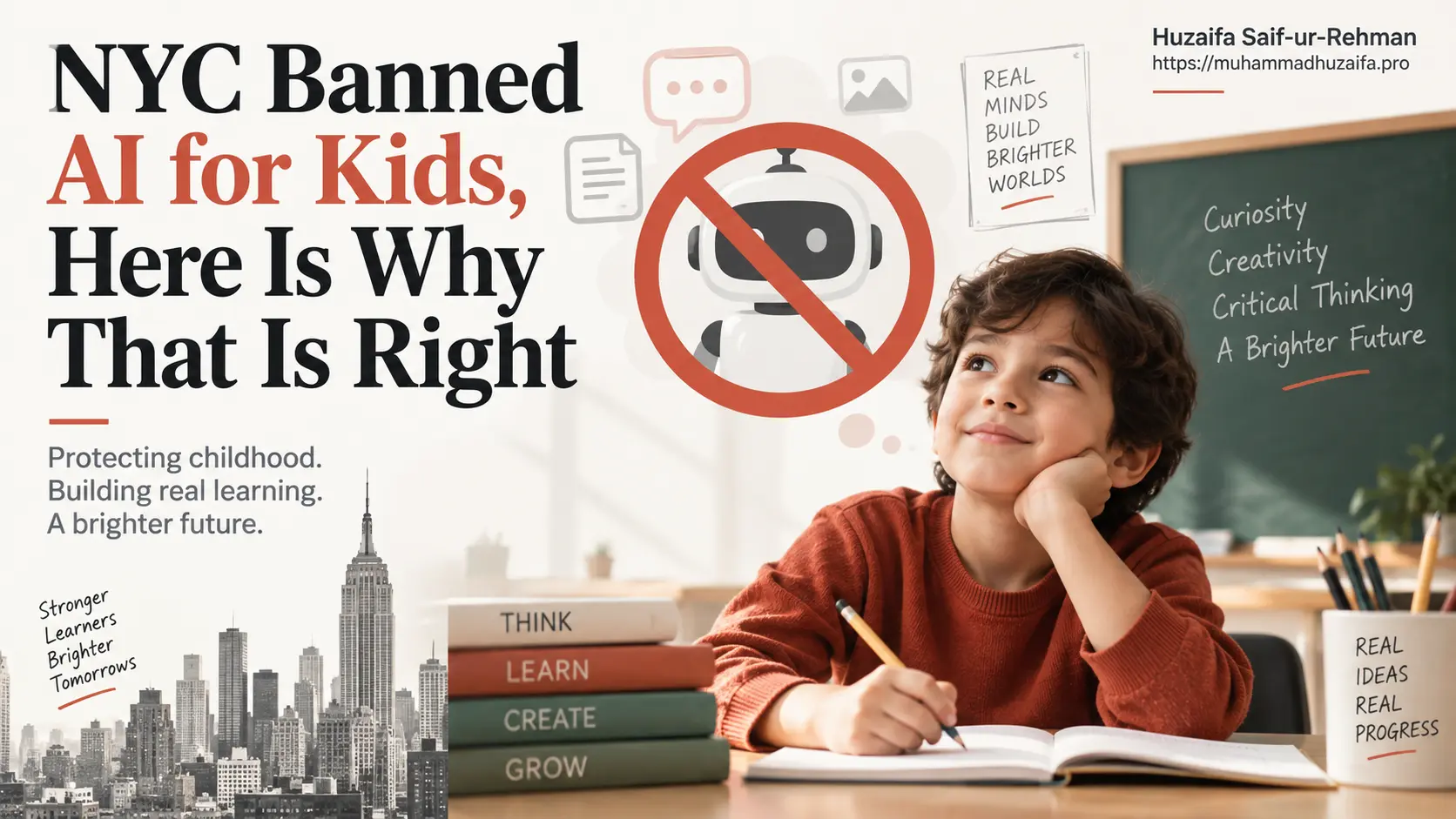
New York City Public Schools, the largest school system in the United States, announced on September 2, 2026 that it is banning generative AI tools for students from pre kindergarten through eighth grade. I think this is the right call, and I want to explain why, using both the facts of the policy and my own view on what children lose when a machine does their thinking for them.
What New York City Public Schools Actually Announced
Mayor Zohran Mamdani and Schools Chancellor Kamar Samuels announced a one year pause on student facing generative AI. Generative AI means tools that write, answer, or create content on request, such as chatbots and AI tutors. The pause covers close to 600,000 students, about two out of every three children in the district.
The rule blocks chatbots, AI tutors, AI powered instructional programs, and companion chatbots meant for emotional support. The district will turn off the AI features in more than 38 programs that schools had already approved, because those programs did not meet the new safety standards.
The policy also sets limits by age. Children from pre kindergarten through second grade will not use individual devices at all, though a shared smart board in the classroom is still allowed. Students in third through fifth grade get a screen time limit of 30 minutes a day. Students in sixth through eighth grade get 45 minutes a day. High school is treated differently. A small number of closely watched pilot classrooms will keep testing AI tools, and every high school student will get two lessons a year on how AI works, its biases, and how to think about its answers critically.
There are exceptions. Students with disabilities who rely on assistive technology, English language learners, and students in career and computer science programs are not covered by the same limits. Teachers are also treated differently from students. They can still use AI to help plan lessons, translate material, or draft messages to parents, but not to grade work, monitor behavior, offer counseling, or write a student's special education plan.
This is also a reversal. New York City schools banned ChatGPT in January 2023, only two months after it launched, then lifted that ban in May 2023. The schools chief at the time admitted the first ban came from what he called knee jerk fear. An early draft of new rules in March 2026 drew pushback from parents and city council members, and this September policy is the revised version.
Why I Agree With the Direction NYC Has Taken
I want to be clear about where I stand before I go further. I am not against AI. I believe AI has already become a core part of daily life, and it is going to touch every profession in some form, whether that profession is medicine, law, engineering, or teaching itself. That much I am fairly certain about.
But being certain that AI will be everywhere is not the same as saying every age group should use it in every way, right now, without limits. A tool can be useful for an adult and still be the wrong thing to hand to a five year old who is still learning how to hold a pencil and form a thought. NYC's policy draws exactly that line, and I think that line is drawn in roughly the right place.
AI Is Not Free, Not Even for One Word
There is a cost to AI that most people never see, and it belongs in this conversation. When a person solves a problem in their head, the cost is a bit of glucose and a few minutes of attention. When an AI model answers the same question, even something as short as a single word, the request still passes through a neural network, a system of billions of connected calculations built to guess the next likely word.
That guess costs real resources. It costs computing time, measured in units called tokens, which are small pieces of text the model processes one at a time. It costs electricity to run the servers doing that computation. Estimates of how much electricity a single AI response uses vary widely, and companies and researchers do not always agree on the numbers, some figures are ten to fifty times higher than what AI companies themselves have reported. Water is also used to cool the data centers that house these servers, though the exact amount depends heavily on the cooling method and location, and is genuinely disputed between sources. What is not disputed is the direction, global electricity use by AI data centers is expected to grow sharply by the end of this decade.
I raise this not to argue against using AI, since I use it myself every day. I raise it because a child asking a chatbot to solve their math homework is not a free action just because no money changed hands. It draws on real electricity and real infrastructure, for a task a human brain could often do at a fraction of the cost, using nothing more than a pencil and a few minutes of effort.
The Gym Analogy, You Cannot Rent Someone Else's Muscles
Think about a person trying to build muscle at the gym. No matter how advanced the machines are, that person still has to lift the weight themselves. A machine that lifted the weight for them would leave the gym looking busy, but their body would never actually get stronger.
Critical thinking works the same way. No matter how powerful AI and large language models become, a person's own ability to reason, judge, and solve problems only grows if they use it. That ability is a kind of mental muscle, and it only strengthens through use, not through watching something else do the work.
This matters most for children, because childhood is exactly the period when the brain is building these habits for the first time. If a child is handed a tool that solves every problem before they have struggled with it, they are not skipping a chore, they are skipping the repetition that builds reasoning itself.
What I Am Seeing in Schools Right Now
I recently went to my children's school to pick up my daughter, and one of the main points in the school's pitch to parents was its AI curriculum. The students this curriculum targets include nursery children, kindergarten students, fifth graders, and eighth graders. This is not a distant trend, it is happening now.
If an eighth or ninth grade student is getting most of their homework done through AI, where does their own thinking actually happen. A child can upload a photo of a math problem to a chatbot and get a full solution back in seconds, without ever sitting with the problem long enough to feel stuck.
Human intelligence naturally varies from person to person. That variation is exactly what produces scientists, inventors, and people who can solve problems nobody else can. If every child is taught that their reasoning should simply defer to whatever a language model says, that variation stops mattering, because everyone is leaning on the same layer underneath them, and the difference between someone who reasons well and someone who does not quietly disappears.
The Cigarette Packet Problem
I do not accept the argument that says, we will teach children how to use AI properly, tell them what they should and should not do, and if they ignore that advice, the responsibility is no longer ours. That argument sounds a lot like selling cigarettes, taxing them, and putting a warning label on the pack, then treating the responsibility as fulfilled.
That is not how responsibility works. If a school or a company introduces a tool into a system full of children, it also takes on the responsibility to make sure that tool is used in the most positive way possible, while actively limiting its downsides. A warning label is not the same as a safeguard.
Realistically, nobody can maintain constant supervision over how a child uses AI, not the school and not even the parents at home. A father is often busy with work, a mother is often busy running the household, and the child sits down to do homework alone. The child types a question into a chatbot, maybe uploads a photo of the problem, and gets a full answer back almost instantly. In that moment, where did the child's own thinking go.
What a Child Loses When the Struggle Disappears
That child was supposed to sit with the problem, feel a little stuck, and push through that discomfort. That struggle is not wasted time, it is the process that builds real thinking. Early research on AI reliance and critical thinking, while still developing and not fully settled, has started to find a pattern, people who lean on AI tools heavily for thinking tasks tend to score lower on critical thinking measures, and the effect looks strongest in younger users. Researchers have also started describing something they call digital amnesia, where students struggle to recall material from work they only recently completed with heavy AI help.
There is also a more basic problem. If a child never builds their own knowledge and judgment, what will they use to check whether an AI's answer is even correct. A person with no foundation of their own has no way to catch a mistake, because they have nothing to compare the answer against.
What Schools Should Actually Do
This is where I think NYC's approach, even with its limits, points in a useful direction. It does not pretend AI does not exist. High schoolers still get regular lessons on how AI works, where it can be biased, and how to question its answers, which is a real form of AI literacy rather than a blanket ban with nothing to replace it. Younger children, meanwhile, get more hands on learning, more play, and more direct teacher guidance, at the exact age when those things build the foundation everything else stands on later.
That is the balance worth copying, protect the years when a child's reasoning is still forming, and once that foundation exists, teach older students to use AI with judgment instead of blind trust. AI is not going anywhere, and I do not think it should. But a child's own mind is not something a machine can build for them, no matter how advanced that machine becomes.