Valkey vs Redis, Should Your Laravel App Switch?
Published on — Last updated
Valkey is a free fork of Redis that started in March 2024. For most Laravel apps, switching is a small change, because Valkey speaks the same protocol as Redis. The harder question is not whether it works. It is whether you have a good reason to move, and what to check before you do.
This is the plain version of valkey vs redis for a Laravel developer. I checked each fact below against the project pages, and I say where a number comes from the project itself.
Why Valkey exists
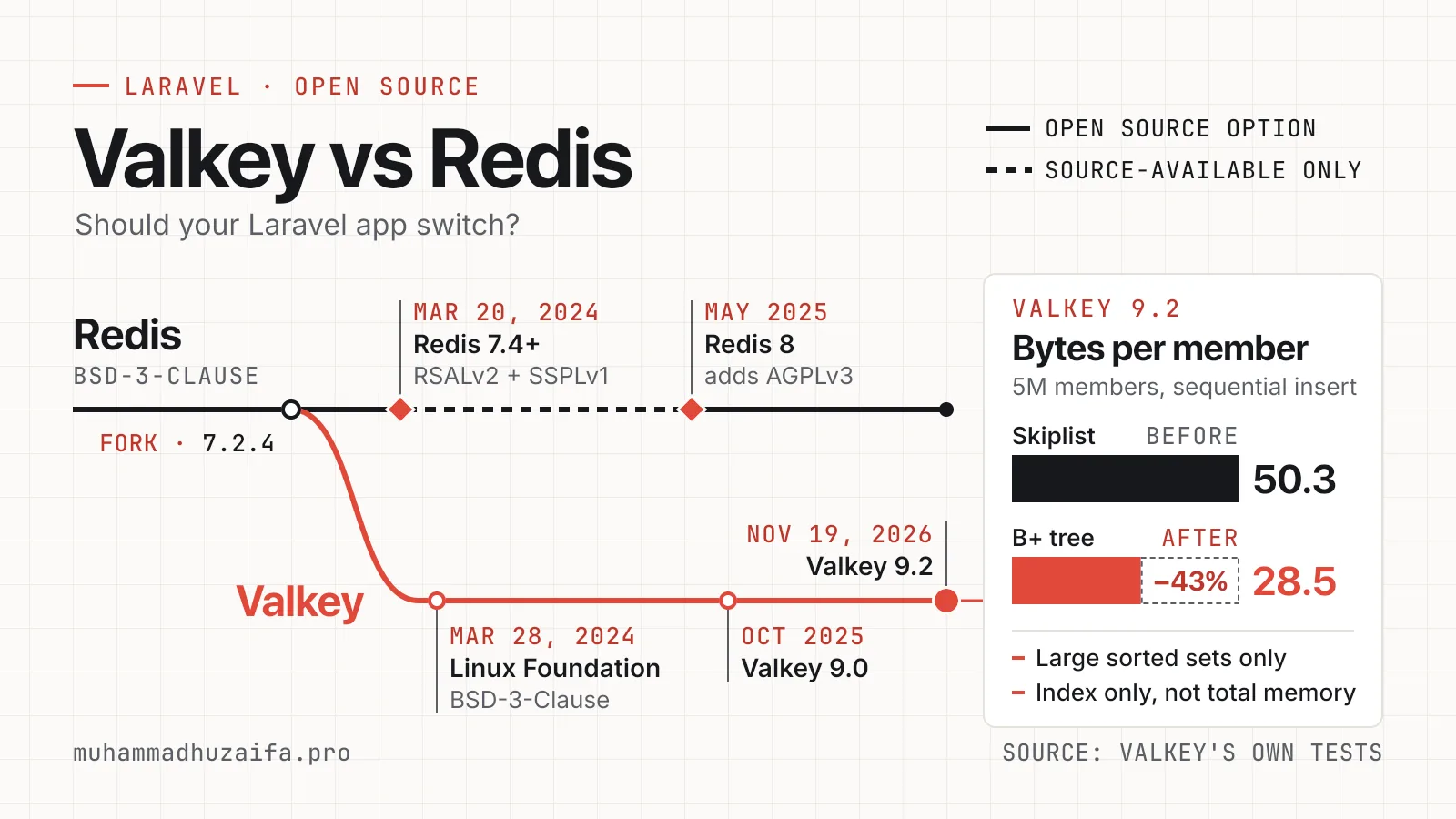
For years, Redis used the three-clause BSD license, which is open source and very permissive. On March 20, 2024, Redis announced that Redis 7.4 and later would use two source-available licenses instead, RSALv2 and SSPLv1. Redis said in the same post that neither license is approved by the Open Source Initiative. It also said cloud providers could no longer use the new code for free to host Redis.
On March 28, 2024, the Linux Foundation announced Valkey in response. It continues from the Redis 7.2.4 code, from before the license change. The announcement named AWS, Google Cloud, Oracle, Ericsson and Snap as supporters. Today the Valkey repository lists the BSD-3-Clause license and says Valkey is an open community project under LF Projects.
Redis changed course in May 2025. It added the AGPLv3 license as an extra option, starting with Redis 8. Redis calls AGPL an OSI-approved license. So Redis can be used under an open source license again. Still, the two are separate projects with separate roadmaps.
For a normal app owner, the license is rarely the deciding point. Redis said that for end users who run it for their own internal use, nothing changes. The license matters most to cloud hosts and to companies that embed Redis in a product they sell.
How Valkey and Redis differ today
As of November 2026, both projects keep adding features. These are the headline items, and the numbers are the projects' own claims, not independent tests.
- Valkey 8.0 added better multi-threading. The release candidate post gave a design target of up to 1.2 million queries per second on AWS r7g, against 380K before.
- Valkey 9.0, announced in October 2025, added hash field expiration and atomic slot migration. It also lets cluster mode use database numbers other than 0. The post claims over 1 billion requests per second on a 2,000 node cluster.
- Valkey 9.2, announced on November 19, 2026, adds opt-in forkless snapshots, compressed replication, ACL roles, and a new structure for large sorted sets. I cover that last item below.
- Redis 8 moved JSON, time series, the query engine and the new vector set type into the core product. Redis also claims over 30 performance improvements, with up to 87% faster commands and 2x throughput.
The most important difference for a migration is the data files. The Valkey migration guide says data from Redis OSS 2.x up to 7.2.x can move to Valkey. It also says that Redis Community Edition 7.4 and later produces data files that Valkey cannot read. Redis 8 is later than 7.4, so that warning applies to it too.
Can a Laravel app switch?
Usually, yes. A Valkey post about Laracon India 2026, dated April 23, 2026, says Valkey is fully protocol-compatible with Redis OSS 7.2. It says switching a Laravel app needs one change, the endpoint in your .env file.
Laravel's own products already rely on this. Laravel Cloud sells a managed cache called Laravel Valkey, described as a fully managed, Redis-compatible cache. Laravel Cloud fills in REDIS_HOST and REDIS_PASSWORD for you. Laravel Forge managed cache clusters are Valkey clusters too. The Laravel 13 Redis docs still use the word Redis everywhere and never mention Valkey, so your redis driver name stays the same.
A switch on your own server can be as small as this.
1REDIS_CLIENT=phpredis2REDIS_HOST=your-valkey-host3REDIS_PORT=63794REDIS_PASSWORD=your-passwordWhat about the PHP client?
Laravel uses PhpRedis by default, and you can switch to Predis. Both work with Valkey. The PhpRedis release notes mention Valkey tests from version 6.1.0, and version 6.3.0 from November 2025 added support for the Valkey DELIFEQ command. Predis describes itself as a Redis and Valkey client for PHP.
Valkey also has its own client family, called Valkey GLIDE. Its PHP version says it is a drop-in replacement client for PhpRedis. You do not need it for a first switch. Keep the client you have and change one thing at a time.
The sorted set claim, checked
A Valkey blog post from November 16, 2026, called From Skiplists to B+ Trees, makes a memory claim. It says a new B+ tree cut per-member memory overhead for large sorted sets by 36 to 43 percent, saving up to 109 MB, in a test with 5 million members.
That is a real result, but the conditions matter.
- The 43 percent case inserted 5 million members of 20 bytes each, in sequential order. Overhead fell from 50.3 bytes to 28.5 bytes per member.
- Random order insertion gave a smaller gain. Overhead fell from 50.3 to 32.0 bytes, which is 36 percent. The savings were about 109 MB for sequential and 92 MB for random.
- The percentage covers only the ordered index. It does not include the member data, so it is not a cut in total memory. The post says the gain shrinks as members get bigger.
- It applies only to large sorted sets. Small ones use a compact listpack encoding and do not change. Valkey's 9.1 post gives the defaults as more than 128 elements, or a member over 64 bytes.
- Valkey did not simply delete the skiplist. It replaced it with a B+ tree. The post does not name a baseline version, and it does not state the hardware used for the memory test.
- The Valkey 9.2 release post says these figures come from the pull request's own testing. The blog post was written while 9.2 was still a release candidate.
This matters to Laravel because the Redis queue driver stores delayed and reserved jobs in sorted sets. A queue with many delayed jobs could gain from this. A small app will see nothing. Before you expect savings, compare MEMORY USAGE on one real sorted set, and check whether OBJECT ENCODING reports btree after you upgrade.
What to check first
- Your current Redis version. Redis 7.2 or older can move to Valkey with the normal tools. The Valkey guide says you can use
REPLICAOFto keep downtime short. With Redis 7.4 or newer, the data files are not compatible, so plan to rebuild instead. - Cache, queue and session data. A cache can be rebuilt, so losing it only costs some speed. Queued jobs and sessions are different. Drain the queue and plan for sessions before you move.
- Redis-only features. The migration guide does not cover Redis Stack data such as JSON or search. If your app or a package uses these, test them first. Plain Laravel cache, queue and session use does not usually need them, but a package might.
- Your host. Laravel Cloud and Forge already sell Valkey. Check what your own host offers and what it costs, because that is often the real reason to switch.
- Your client version. Use a current release of PhpRedis or Predis.
- Staging first. Point a staging copy at Valkey. Run your queue workers, Horizon if you use it, and a few real user flows. The Valkey Laracon post says Horizon works with Valkey, but I would still run it on your own data.
After the move, watch queue and cache numbers for a few days. My write-up on Laravel Pulse MCP shows one way to read that data.
So, should you switch?
It depends on where you are today. If you run Redis 7.2 or older, want a vendor-neutral BSD project, and can test first, Valkey is a low-risk move. If your host already runs Valkey, you may be using it already. If you run Redis 8 with JSON or vector features, do not switch until you have tested those parts. If everything works and the license is not a problem for you, nothing forces a change.
The best move is a boring one. Test on a copy, measure, and change the endpoint last.
If you want a second pair of eyes on a cache move, or on the other systems around your Laravel app, see my integrations work or hire a Laravel engineer. If your app is slow and you want to find the cause first, I offer a fixed-price Laravel performance optimization.