Inkling 2 From Thinking Machines Lab, Small and Mini Explained
Published on — Last updated
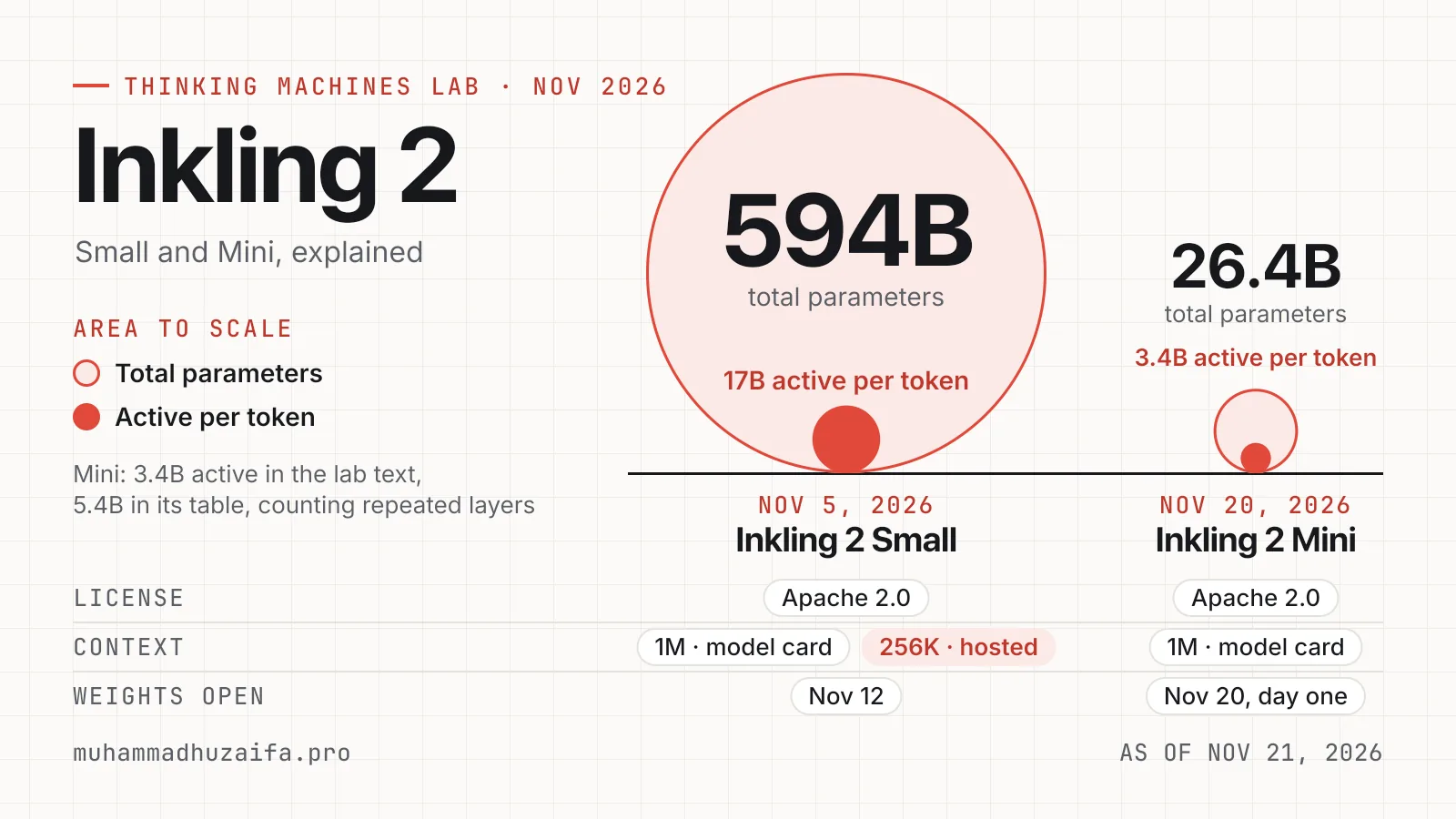
Thinking Machines Lab, an AI research company, released two models in its Inkling 2 family in November 2026. Inkling 2 Small came out on November 5. Inkling 2 Mini came out on November 20. You may see both names in the news. Both are real. They are two different models.
I checked the lab's own pages, its Hugging Face pages, VentureBeat and Artificial Analysis. Below is what they agree on and where they do not. Benchmark scores are mostly self-reported by the lab, so I mark them that way.
What was released and when
As of November 21, 2026, the facts line up like this.
- Inkling 2 Small. Announced on November 5, 2026. It is a large model with 594 billion total parameters, and 17 billion of them are active for each token.
- Inkling 2 Mini. Released on November 20, 2026. It is a small model with 26.4 billion total parameters, built to run on a laptop or a small desktop machine.
Both take text and images as input and give text as output. Neither supports audio. Both use a mixture-of-experts design, which means only part of the model works on each token.
Inkling 2 Small
At launch, Small was closed weight and available only through the lab's Tinker platform, according to the lab's announcement. VentureBeat reported on November 6 that the lab planned to release the weights under the Apache 2.0 license after outside safety checks. On November 12, the lab added an update saying the weights are now on Hugging Face. The model card lists Apache 2.0. News from November 5 to 7 that calls Small closed is now out of date.
On context length, the model card says up to 1 million tokens. VentureBeat found that the serverless version on Tinker lists 256K. These do not conflict. One is what the model supports, and the other is what that hosted option offers.
Small is not a laptop model. The model card says the NVFP4 checkpoint needs at least 500GB of combined GPU memory, and the MXFP8 checkpoint needs at least 800GB. Most teams will use a hosted provider. The lab's update lists NVIDIA, Fireworks, Together, Baseten, Nebius, Modal and Cloudflare.
On quality, Artificial Analysis gave Small a score of 31 on its Intelligence Index, which is a score from an outside group. The lab's own table lists 30.6, so this is likely rounding. Artificial Analysis also says Small used about 150K output tokens per Intelligence Index task. More output tokens can mean a higher bill.
On price, VentureBeat listed Tinker serverless rates of $0.30 per million input tokens and $1 per million output tokens. That was on November 6, and the service was still in beta, so check the current price.
Inkling 2 Mini
Mini is the model to watch if you want to run AI on your own machine. The lab's announcement calls it a looped transformer. It stores 24 layers and runs the middle layers three times for every token. The checkpoint is about 20GB. The lab says it runs on Macs with at least 32GB of memory and on the NVIDIA DGX Spark.
The weights are on Hugging Face from day one. The Hugging Face model card lists Apache 2.0 and says the context window is up to 1 million tokens. The lab's announcement page does not state either of those, so I took them from the model card.
The lab reports 48.2% on DeepSWE v1.1, a coding test, against 42.2% for Qwen3.8-27B in its own table. Artificial Analysis scores Mini 20 on its Intelligence Index, against a median of 10 for comparable models. The lab's table lists 20.1 and shows it tied with Qwen3.8-27B. The same table has Qwen3.8-27B ahead on Terminal Bench v2.1, 73.0 against 71.6, so a claim that Mini leads every coding test would be too broad.
The lab is open about the weak points. It says Mini is not the strongest small model for multi-turn chat or for instructions with many rules. It also scores low on factual knowledge, because looping the layers does not store more facts.
Where the sources disagree
Most facts match. A few details need care.
- Active size of Mini. The lab text says 3.4 billion active parameters. Its table says 5.4 billion. The lab says 5.4 billion counts the repeated layers, so both numbers can be right.
- Context length of Small. One million tokens on the model card and 256K on the hosted service, as above.
- Benchmarks. Almost all come from the lab. Only the Artificial Analysis scores are from outside, and the test setups differ between models.
What this means for a business
I would not pick a model from a launch table. Test it on your own data and tasks. Here are three points worth checking.
- If you need a private model on one machine, Mini fits the size. Test its chat quality first, since the lab says it is weaker there.
- If you want a stronger model without running hardware, Small through a hosted provider is the route. Watch the output length, because it affects cost.
- The Mini model card links an acceptable use policy next to its Apache 2.0 license. Both model cards advise against medical, legal and safety-critical use without more work. Read them before you build on either model.
If you plan to connect a model like this to real business systems, my AI engineering page shows how I approach that work. My post on why your AI agent is not a coworker covers what to expect from agents once they are in place.