What Is a Forward Deployed Engineer, and Do You Need One?
Published on — Last updated
A forward deployed engineer, often called an FDE, is a software engineer who works inside a customer's team and builds working software on the customer's own systems. The role started at Palantir. Today many AI companies hire for it, because their products only work when someone connects them to messy real data.
This post explains what the role is, what the work looks like, how it differs from a solutions engineer or a consultant, and when a company should hire one. I also cover forward deployed engineer salary figures, and I label where each number comes from.
What a forward deployed engineer does
Gergely Orosz of The Pragmatic Engineer defines an FDE as a software engineer who moves between two places. One is embedded with customer teams. The other is the core product engineering team.
The word that matters is engineer. First Round Review says the FDE is still very much an engineer who writes and debugs production code. That is the main difference from a sales role. The goal is not to close a deal or run a demo. The goal is to make the product work in the customer's real setting.
Where the role came from
Palantir created the role. Palantir calls its FDEs Deltas. According to Palantir's own blog, as quoted by The Pragmatic Engineer, a regular Palantir developer works on one capability for many customers. A Delta works on one customer with many capabilities.
The sources disagree on timing. The Pragmatic Engineer says the role began in the early 2010s, and Palantir was founded in 2003. First Round says Palantir created the model almost 20 years ago. I would not trust a precise start date from either.
The Pragmatic Engineer also says Palantir had more FDEs than regular engineers until about 2016, when it launched its Foundry product and moved many of them into core product work. The article does not link a source for that headcount claim.
Why AI companies hire them now
PostHog gives three reasons in its own explainer. Customers are slow to share sensitive data, so FDEs earn longer access. AI deals are large enough to pay for engineers who work with a customer for months. And many buyers doubt AI until they see it work on their own data.
Venture firm a16z, in a June 2025 essay by partner Joe Schmidt, adds that enterprise AI products need deep integrations. Someone has to connect the model to the customer's databases, APIs and workflows. The essay's title calls the FDE the hottest job in startups. That is an opinion from an investor in this space, not a study.
Colin Jarvis, Head of Forward Deployed Engineering at OpenAI, says in The Pragmatic Engineer that what customers describe in early scoping often does not match the data and systems on the ground. That gap is the work.
Forward deployed engineer jobs are growing fast
As of November 2026, every source I found shows steep growth, but the numbers do not match.
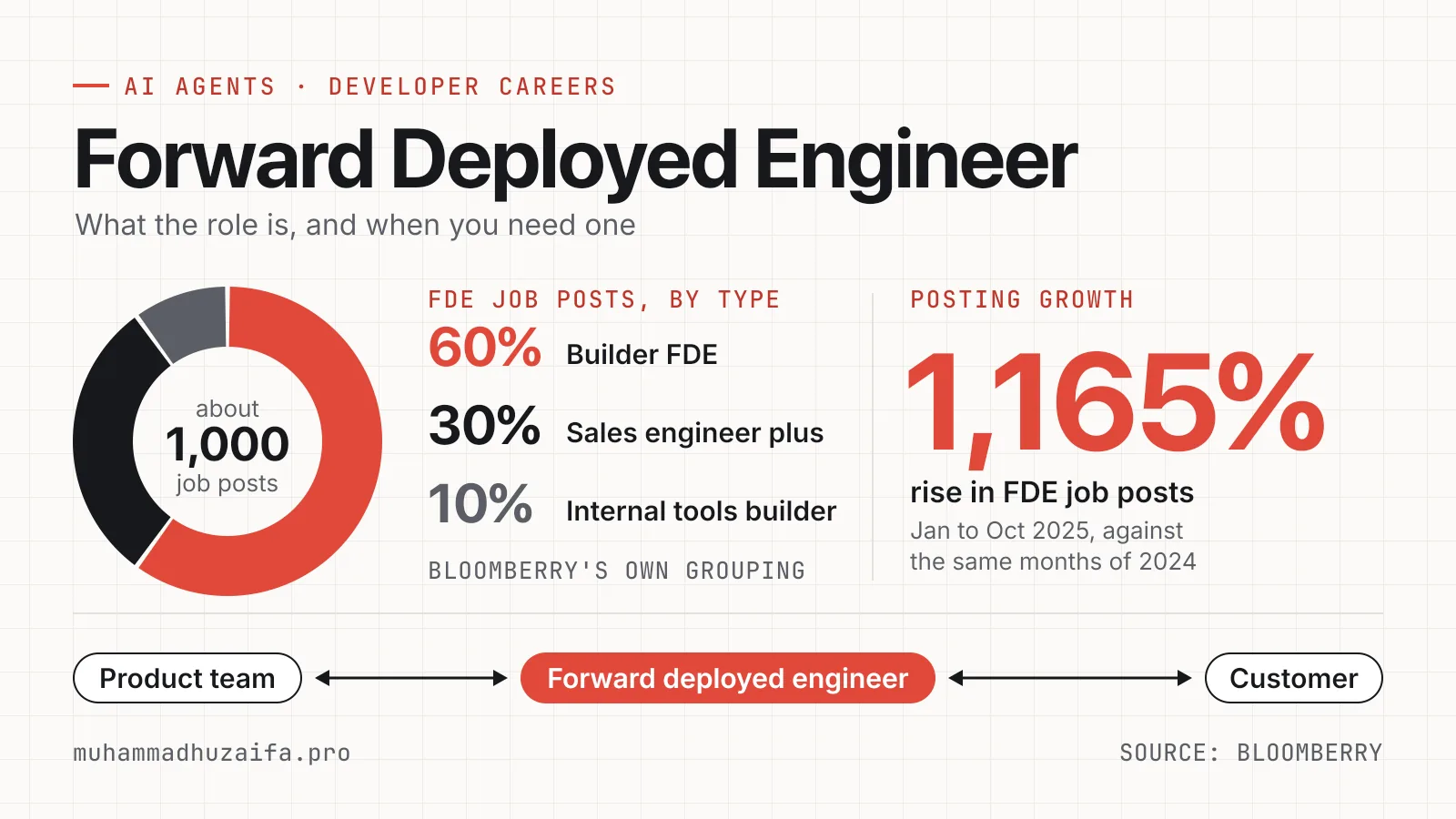
- Bloomberry, an independent analyst, counted a 1,165% rise in FDE job posts from January to October 2025, against the same months of 2024.
- Fortune, using Lightcast data, reports a rise of over 1,000% from January to August 2026, against the same months of 2025.
- First Round, citing the Financial Times, says about 800% from January to September 2025.
The windows and the data sources differ, so do not compare them. They also do not say how many jobs exist, only how fast the count grew.
What the work looks like day to day
The Pragmatic Engineer describes OpenAI projects in three phases. First, a couple of days on site to scope the problem and build a prototype with synthetic data. Second, agreeing what success means and building tests that measure it. Third, delivery. FDEs are on site a few days a week, and the building typically happens at OpenAI's offices before they demo to the customer.
PostHog's public handbook adds useful detail. Before delivery, the FDE agrees a short brief with the customer. It states the outcome, the milestones, the rough timing and what done means. PostHog says to keep the scope small, because it is cheaper to grow a tight scope than to undo a loose one. It also tells its FDEs to use built-in product features before writing custom code, so the customer can maintain the result.
The Pragmatic Engineer quotes a Palantir FDE from a 2019 Palantir blog post. Most weeks, the FDE said, include a couple of days at the customer's site. The rest goes to coding, reviews and planning. Treat it as one example, not a rule.
FDE vs solutions engineer vs consultant
The titles overlap, and companies use them loosely. Bloomberry sorted about 1,000 FDE job posts into three types. This is the author's own grouping, not a standard.
- Builder FDE, 60% of posts. An engineer who embeds with customers and builds and runs production systems.
- Sales engineer plus, 30%. A solutions or sales engineering job with a new title, which hands work to an implementation team.
- Internal tools builder, 10%. A sales operations role that builds tools for staff. Bloomberry says it should not carry the FDE name at all.
The Pragmatic Engineer adds two more differences. OpenAI's solutions architects are mostly advisors. They rarely write code on customer systems. And a consultant often gives one-off advice, while an FDE stays with the customer over a longer time.
First Round's Tiffany Siu gives a simple test. If the job is closing deals or running demos, the company probably wants someone closer to sales.
Forward deployed engineer salary
Pay figures come from job sites and data vendors, so they are rough guides. They are not official, and they measure different things.
- Levels.fyi is a pay site where people report their own pay. Its US page shows median total pay of $225,000 for FDEs, with the middle half between $170,000 and $300,000. It is based on 165 reports and was updated on November 21, 2026. The figure moves as new reports arrive.
- Bloomberry looked at about 1,000 job posts from a jobs data provider. It found a median salary of $173,816, counting only posts that list a pay range. The posts are from 2025. About 70% mention equity.
- Lightcast data shared by Dice, reported by Fortune, shows a median advertised salary above $188,000 for FDEs. The same data shows about $145,000 for traditional software engineers.
- Fortune says compensation for some forward-deployed roles at Anthropic can reach $400,000. This is Fortune's claim, and I did not trace it to the original job post.
Base pay, total pay and advertised pay are not the same thing. Do not mix them in one comparison.
When should a company hire one?
First Round's guide gives three checks, plus one point on money.
- You sell to larger customers. James Honsa, former head of legal engineering at Ironclad, calls the role an upmarket motion by definition.
- You do not dictate how customers use your product. A fixed vision is a poor fit, because FDEs help find new product paths.
- You do not have one uniform customer type. Your product should fit many different use cases. The work is hard, customer-specific problems that off-the-shelf software cannot solve.
Frank Bien, a former CEO of Looker quoted in the same guide, adds a point on money. Know your unit economics well enough to see if the spend pays back.
PostHog adds that if your current playbook for finding product fit is working, you probably do not need an FDE. First Round also warns that you may not need a whole team of them. If you mainly want more customer feedback, a product manager or a customer-facing engineer may be enough. In a related First Round piece, Honsa calls the FDE a blunt instrument for a whole business.
Can a freelance engineer do this work?
The shape of the work is not tied to a job title. It is embedded, outcome-based and hands-on. A freelance engineer can work that way for a company that does not need, or cannot yet afford, a full-time hire.
Here is what I think carries over, in my own words. Agree a brief with a clear outcome and a clear meaning of done. Scope small and price by milestone, as PostHog does. Work inside the customer's real systems. Use what already exists before writing new code. Write down what you learn.
Two things do not carry over, in my view. A freelancer has no product team to feed lessons back to. And a freelancer cannot shape the roadmap the way an in-house FDE can. That makes the freelance version a better fit for integration-heavy AI work, where the problem is connecting a model or agent to systems the customer already runs.
That is the kind of work I offer. I have built a HubSpot MCP server that lets an AI agent work with HubSpot lists and segments. I also do API, ERP, CRM and payment integrations, and I cover the wider scope on my AI engineering page.
If you want to see how I would work this way with your team, read my forward deployed engineer page.