Oracle Bans AI Generated Code From OpenJDK
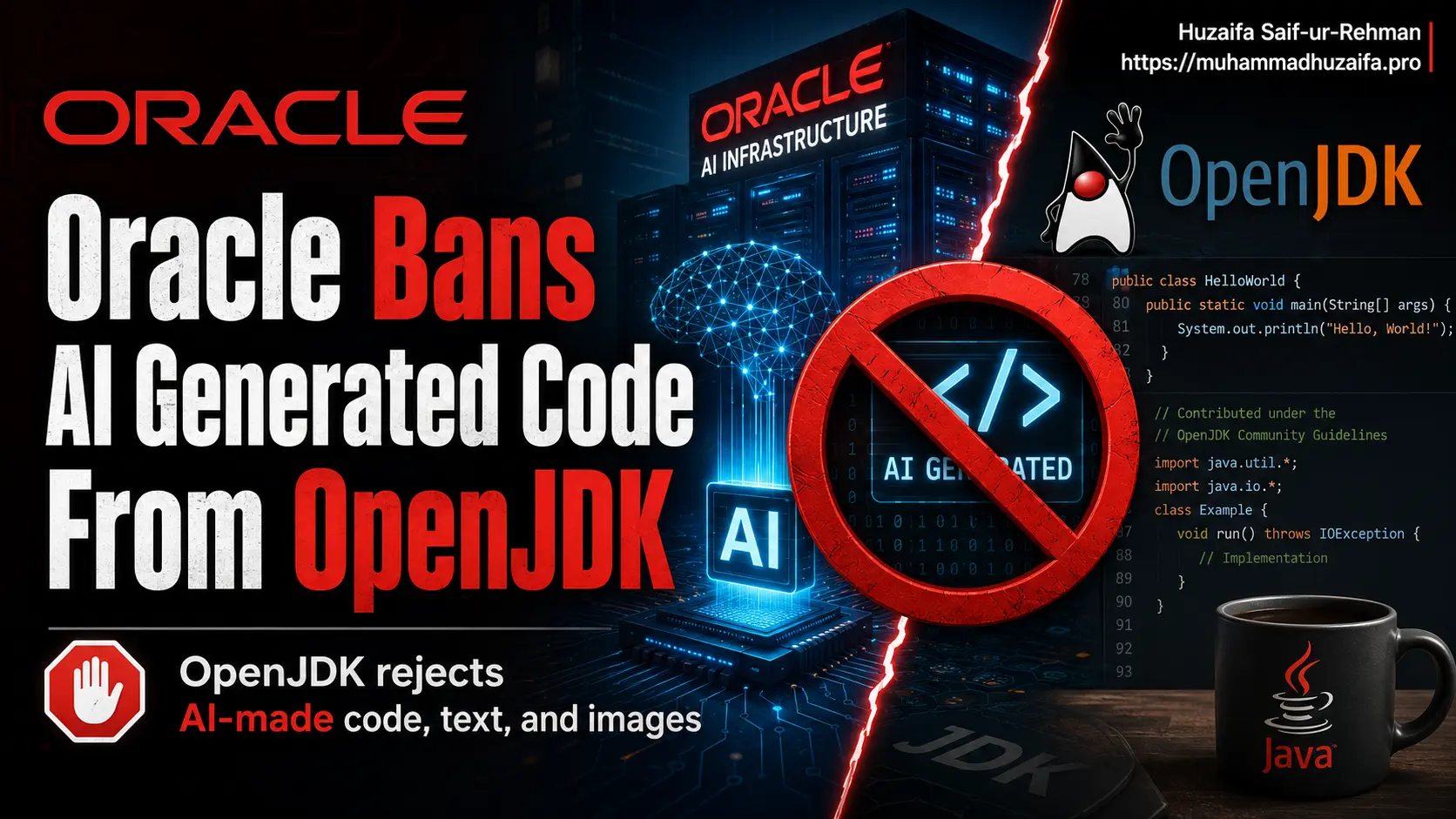
Oracle's OpenJDK Governing Board has banned AI generated content from OpenJDK contributions. The policy, published in April 2026, prohibits code, text, and images produced in whole or in part by large language models, diffusion models, or similar deep learning systems from entering OpenJDK repositories, pull requests, emails, wiki pages, or bug reports.
The decision stands out because Oracle is simultaneously one of the most aggressive corporate spenders on AI infrastructure in the industry, with a seventy billion dollar commitment to AI compute. The same company that wants to sell the world AI infrastructure does not want AI writing the code for its own flagship open source project.
What the OpenJDK policy actually bans
The policy text is direct. Contributions must not include content generated, in part or in full, by large language models, diffusion models, or similar deep learning systems. This applies broadly, covering source code, documentation, pull request descriptions, mailing list messages, wiki edits, and entries in the JDK Bug System.
The scope leaves little room for partial use. According to the policy's own FAQ, a contributor who has an AI tool write one hundred lines of code and then edits only ten of those lines still cannot submit the result. The contribution is still considered partly AI generated, and that alone disqualifies it.
What counts as AI generated content
Any output from a large language model, a diffusion model, or a comparable generative system counts, regardless of how much a human later edits it. There is no threshold of human modification that makes AI assisted output acceptable under this policy.
What contributors can still do
Developers may still use AI tools privately. The policy allows using generative AI to debug code, review existing code, and support personal research and understanding. The restriction applies only to what gets submitted to the project, not to how a contributor works while preparing that submission.
Why Oracle says it made this call
The OpenJDK Governing Board gave three reasons for the ban.
Reviewer burden
OpenJDK relies on a limited pool of human reviewers. A flood of AI generated submissions that look plausible but contain subtle errors would consume reviewer time that the project does not have to spare.
Safety and security
The JDK underpins software running in banks, government systems, and countless production environments worldwide. The board argues that plausible looking but incorrect code creates unacceptable risk in software at that level of criticality.
Unresolved intellectual property questions
Every OpenJDK contributor signs the Oracle Contributor Agreement, which requires the contributor to own the intellectual property rights they are granting to Oracle without restriction. Whether a person actually owns the rights to output produced by an AI model is, in the board's own words, the subject of active litigation. Oracle is not willing to accept contributions built on IP ownership that courts have not yet settled.
The contradiction, Oracle's own AI bet
A seventy billion dollar infrastructure commitment
Oracle has committed seventy billion dollars to AI infrastructure, an increase from a previous commitment of fifty five point seven billion dollars. That spending has not come without cost to the company's financial position. S&P downgraded Oracle's credit rating to BBB minus, just one notch above junk status, citing an uncertain path to making money on the investment. Oracle has also cut twenty one thousand jobs, a move the company has tied to its AI deployment strategy.
Ellison's public comments on AI written code
Oracle co-founder Larry Ellison has spoken openly about AI writing code inside the company. He has described telling AI models what the company wants built and letting the model produce the step by step process to get there. Oracle co-CEO Mike Sicilia has said AI tools let smaller engineering teams deliver more complete solutions more quickly.
Neither executive has publicly explained why code produced this way is acceptable for Oracle's commercial and internal work but not acceptable for the open source project Oracle stewards for the rest of the software industry.
GraalVM took the opposite position
The contradiction gets sharper inside Oracle's own portfolio. GraalVM, a polyglot virtual machine project also backed by Oracle, adopted a policy that permits AI assisted contributions. Contributors may use AI coding assistants when preparing submissions, provided they take full accountability for the result, understand the code completely, and accept that maintainers retain full discretion to reject anything a contributor cannot demonstrate they understand.
GraalVM's approach was explicitly modeled on the Linux kernel's AI coding assistants policy, which takes a similar accountability first stance rather than a blanket prohibition. Two projects under the same corporate umbrella, governed by the same Oracle Contributor Agreement, reached opposite conclusions about the same underlying legal and technical risk.
What this means for open source contributors
For anyone contributing to OpenJDK, the practical guidance is simple. Use AI tools for learning, debugging, and reviewing your own understanding of the codebase, but write and submit your actual contributions yourself. Reviewers are likely to scrutinize submissions more closely going forward, and a policy violation risks rejection regardless of how much human editing occurred afterward.
For maintainers of other open source projects, OpenJDK's policy and GraalVM's contrasting one both offer a template. A project handling safety critical infrastructure with limited reviewer capacity may lean toward OpenJDK's blanket restriction. A project willing to place the accountability burden on the contributor, similar to the Linux kernel's approach, has a working alternative already in production at GraalVM.
The wider industry has not settled this question yet, and Oracle's own two projects prove that even one company has not settled it internally.