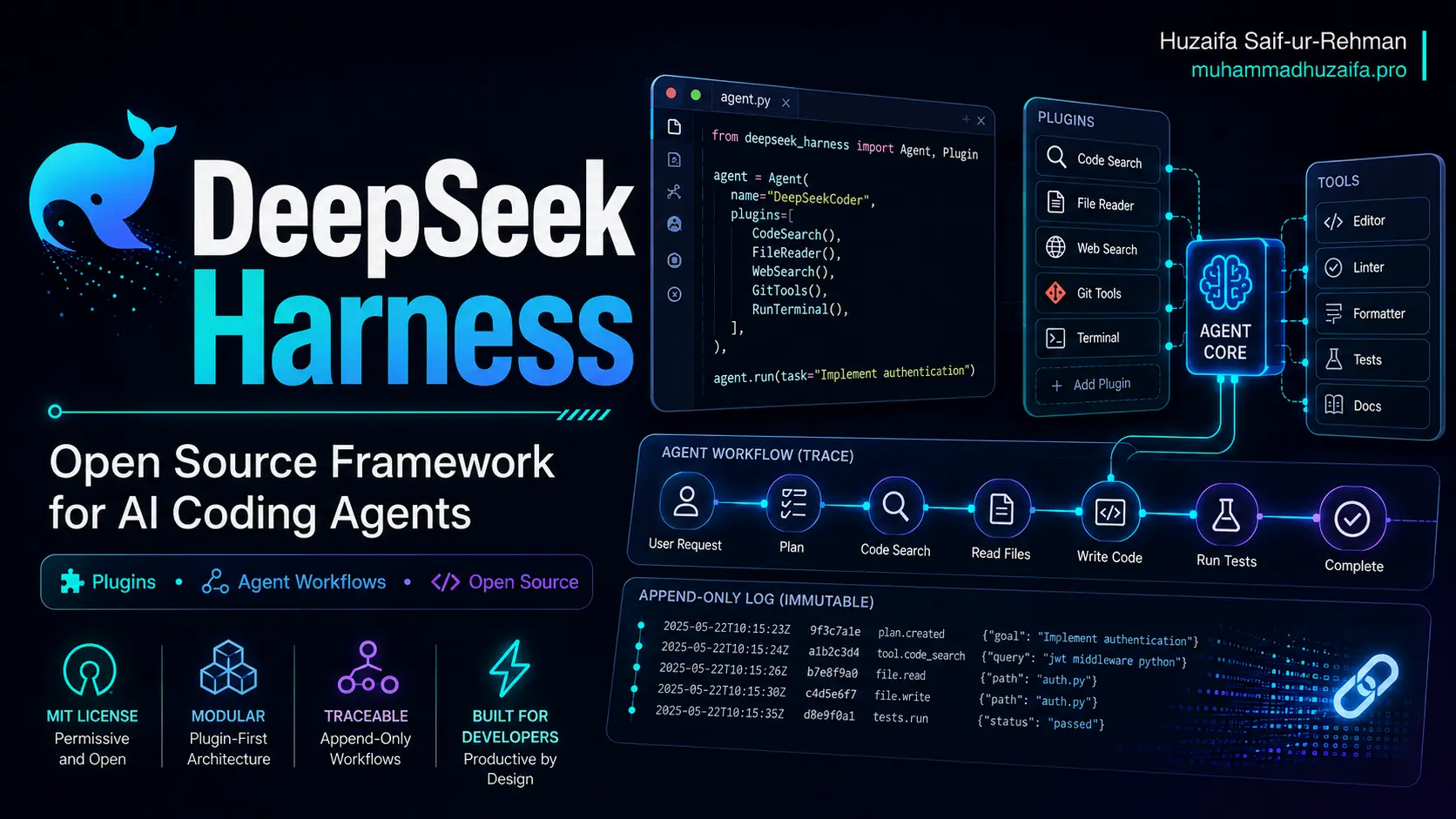
DeepSeek Harness is a free, open source framework for building AI coding agents. DeepSeek AI released it on August 13, 2026, as a developer preview under the MIT license. It gives developers a way to build agents like Claude Code or OpenAI Codex, but with every part of the system open for them to change.
The core idea, everything is a plugin
Most coding agents ship as one fixed package. The model, the tools, the file editor, and the user interface all come bundled together. DeepSeek Harness takes a different approach. It treats every part of the agent as a plugin, a small piece of code you can swap out or replace.
This covers the model the agent uses, its tools, its skills, how it saves sessions, where it runs code safely, how it stores data, its main loop, its task scheduling, and its user interface. A developer can replace any one of these pieces without touching the rest of the system.
DeepSeek pairs this with a second rule, every run must be traceable. The system keeps an append only log, a record that only grows and is never edited, of what happened during a run. This log stores the system prompts, the model's reasoning steps, every tool call and its result, and any work handed off to a sub agent. Because the log is complete, a developer can resume a run, fork it into a new branch, search through it, or replay it step by step.
Cordis, the engine under the hood
DeepSeek Harness is built on Cordis, a smaller framework that handles the plugin system itself. Cordis treats a shared context as a kind of directory. A plugin can register itself under a name, such as tools or llm, and other parts of the system find it by that name instead of importing it directly.
Cordis also manages load order. If one plugin needs another, it declares that dependency, and Cordis works out the correct order to start everything. This is a workflow heuristic worth flagging, not a Google ranking rule, but it matters here because it is the actual technical reason DeepSeek Harness can be this modular without breaking.
The four runtime modes
DeepSeek Harness ships with four modes, each suited to a different kind of task.
Standard mode is the full coding agent. It reads and edits files, runs shell commands, searches your code and the web, keeps a plan, and can hand off work to sub agents.
Code mode has the model write TypeScript code to carry out multi step operations, instead of making many separate tool calls.
Minimal mode strips the agent down to just a shell and a file editor. DeepSeek used this exact mode to benchmark its new V4-Pro model on public coding agent tasks, which is worth knowing if you compare those benchmark numbers to other tools.
Creator mode is for building and testing your own custom presets, with tools to inspect the system while it runs.
How to install and run it
The fastest way to try DeepSeek Harness is through npm, which requires Node.js installed on your machine.
1npx @deepseek-ai/dsh webThis command starts a local web interface, by default at http://127.0.0.1:3080, where you pick a workspace folder and approve any sensitive actions the agent wants to take. Developers who want to build from source can clone the GitHub repository and build it with pnpm instead.
Because this is a v0.1 developer preview, the project's own documentation warns that there will be compatibility breaking changes. Treat any code or workflow you build on it today as likely to need updates.
What it can already do
Even in preview, DeepSeek Harness already inspects repositories, edits files, runs shell commands, searches files and the web, keeps a running plan, invokes skills, delegates tasks to sub agents, and enforces approval policies before risky actions run. These are the same core abilities that make Claude Code and Codex full coding agents rather than simple autocomplete tools.
DeepSeek Harness vs Claude Code and Codex
DeepSeek Harness is not a finished replacement for Claude Code or Codex yet. It is best understood as an open, model agnostic alternative to the agent infrastructure that sits underneath them.
Here is how the three compare, based on public reporting and each project's own documentation as of August 2026.
| Area | DeepSeek Harness | Claude Code | OpenAI Codex |
|---|---|---|---|
| Read, edit, and test a repo | Yes | Yes | Yes |
| Shell and dev tools | Yes | Yes | Yes |
| Planning and sub agents | Yes | Yes | Yes |
| Permissions and sandboxing | Yes, set through plugins | Yes, mature built in system | Yes, granular controls |
| Interfaces | Local web app, headless command, Python SDK | Terminal, VS Code, JetBrains, desktop, browser, mobile, Slack | CLI, IDE extension, desktop app, web, other integrations |
| Hosted background agents | Not offered as a DeepSeek managed service | Yes | Yes |
| GitHub pull request workflow | Not a finished integration yet | GitHub Actions, automatic reviews, issue to PR flows | Cloud tasks, automatic reviews, PR fixes, GitHub Action |
| Model choice | DeepSeek, Anthropic, OpenAI, and other compatible endpoints | Mainly Claude models | Mainly OpenAI models, configurable in the open source CLI |
| Maturity | Developer preview, breaking changes expected | Established commercial product | Established commercial product plus an open source CLI |
| License | MIT | Commercial, with extension points | CLI is open source, cloud and app services are managed |
The clearest gap today is around finished products built on top of the agent loop, things like hosted background agents and a polished GitHub pull request workflow. Claude Code and Codex have both built those out. DeepSeek Harness has the underlying pieces, approval policies, sub agents, tool calling, but has not yet packaged them the same way.
The clearest strength is openness. Because the model itself is just another plugin, a team can point DeepSeek Harness at DeepSeek's own models, Anthropic's models, OpenAI's models, or a custom endpoint, without being tied to one vendor.
Why this launch matters
DeepSeek Harness arrived alongside the general release of DeepSeek-V4-Pro, an updated model built for agent workloads. That timing is not a coincidence. Until now, competition between AI labs was mostly about model quality and token price. Harness moves DeepSeek into a different layer, the software that decides how a model calls tools, edits files, manages sessions, and runs long, multi step tasks.
That layer is harder for a developer to swap than a model. You can often change which model an application calls with a small config edit. Replacing the whole system that manages your agent's tools, memory, and workflow is a much bigger job. By open sourcing that layer, DeepSeek is competing for a stickier, more durable part of the developer relationship, not just for the top spot on a benchmark chart.
Current limits, it is still a preview
Be clear eyed about where the project stands today. It is a v0.1 developer preview. The maintainers say plainly that breaking changes are coming. It does not yet offer a DeepSeek managed hosted agent service, and its GitHub pull request workflow is not yet a finished feature the way it is in Claude Code or Codex. If you plan to build production tools on it, expect to update your code as the framework changes.
Should you try it
If you want to experiment with a fully open, swappable agent framework, or you want to run agents against more than one model provider without being locked into one vendor's stack, DeepSeek Harness is worth a look today. If you need a stable, fully supported product with hosted background agents and a mature GitHub workflow right now, Claude Code or Codex remain the safer choice until Harness matures past preview.